Putting It All Together with PopKit
How workflow orchestration tools bring all these pieces into a coherent system
Part 8 of the Agent-Ready Development Series
Everything we’ve discussed works well for single projects. But what happens when you have:
Suddenly, the simple patterns get complicated. Where does CLAUDE.md live? How do you run tests for just your changes? How does an AI assistant navigate across project boundaries?
Let’s solve this.
First, let’s be clear about what we’re discussing:
Multi-repo: Each project in its own repository
org/
├── frontend-repo/
├── backend-repo/
├── shared-utils-repo/
└── mobile-repo/Monorepo: All projects in one repository
org-monorepo/
├── apps/
│   ├── frontend/
│   ├── backend/
│   └── mobile/
└── packages/
└── shared-utils/| Aspect | Multi-repo | Monorepo |
|---|---|---|
| Cross-project context | Must switch repos | Single codebase |
| Shared code changes | Coordinate across repos | Single PR |
| Consistent tooling | Different per repo | One configuration |
| AI navigation | Limited to one repo | Full visibility |
When an AI assistant works in a monorepo, it can:
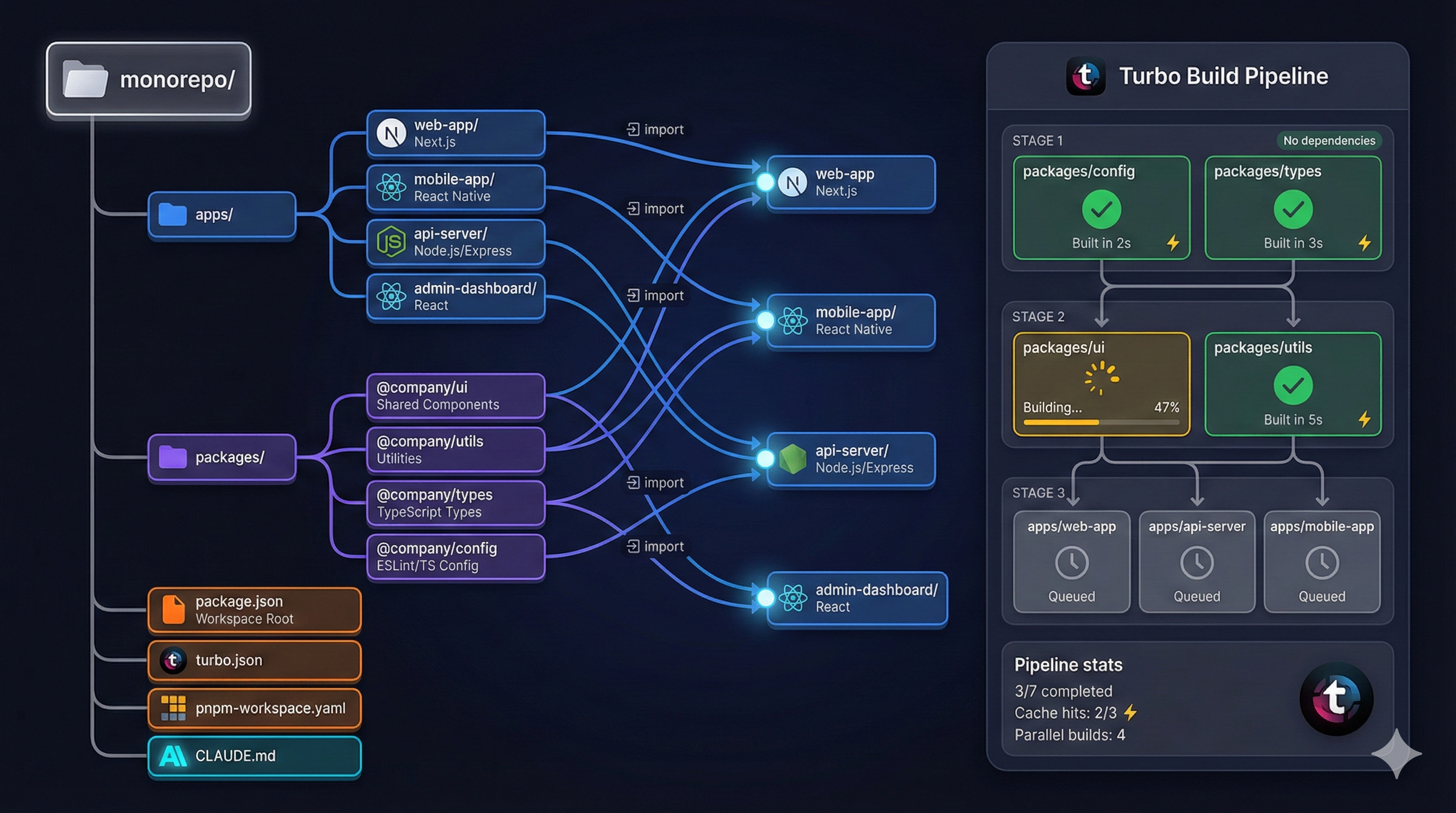
Here’s the structure I recommend:
monorepo/
├── apps/                    # Deployable applications
│   ├── web/                # React frontend
│   ├── api/                # Express backend
│   ├── mobile/             # React Native app
│   └── admin/              # Admin dashboard
├── packages/               # Shared packages
│   ├── ui/                 # Shared UI components
│   ├── utils/              # Shared utilities
│   ├── types/              # Shared TypeScript types
│   ├── config/             # Shared configs (eslint, tsconfig)
│   └── api-client/         # Generated API client
├── tools/                  # Build and development tools
│   ├── scripts/            # Build scripts
│   └── generators/         # Code generators
├── docs/                   # Project-wide documentation
│   ├── architecture.md
│   └── adr/
├── .github/                # GitHub configuration
├── CLAUDE.md               # Root AI instructions
├── package.json            # Root package.json
├── pnpm-workspace.yaml     # Workspace configuration
└── turbo.json # Turborepo configuration# pnpm-workspace.yaml
packages:
- 'apps/*'
- 'packages/*'
- 'tools/*'// package.json (root)
{
"name": "monorepo",
"private": true,
"scripts": {
"dev": "turbo run dev",
"build": "turbo run build",
"test": "turbo run test",
"lint": "turbo run lint",
"typecheck": "turbo run typecheck"
},
"devDependencies": {
"turbo": "^2.0.0"
}
}Turborepo orchestrates builds across packages:
// turbo.json
{
  "$schema": "https://turbo.build/schema.json",
  "globalDependencies": ["**/.env.*local"],
  "pipeline": {
    "build": {
      "dependsOn": ["^build"],
      "outputs": ["dist/**", ".next/**"],
      "cache": true
    },
    "test": {
      "dependsOn": ["build"],
      "inputs": ["src/**", "tests/**"],
      "cache": true
    },
    "lint": {
      "cache": true
    },
    "typecheck": {
      "dependsOn": ["^build"],
      "cache": true
    },
    "dev": {
      "cache": false,
      "persistent": true
    }
  }
}
What this does:
build - Builds packages in dependency order (^build)test - Runs tests after builds completelint - Lints in parallel (no dependencies)typecheck - Type checks after dependencies are builtdev - Runs dev servers persistentlyOnly run tasks for changed packages:
# All affected by changes since main
turbo run test --filter=[origin/main]

# Only the web app and its dependencies
turbo run build --filter=web...

# Only packages that depend on shared-utils
turbo run test --filter=...shared-utilsEach level gets its own AI instructions:
# Monorepo AI Development Guide

## Overview

This monorepo contains 4 applications and 5 shared packages.
Use pnpm for package management and Turborepo for orchestration.

## Quick Commands

    pnpm install          # Install all dependencies
    pnpm dev             # Start all apps in dev mode
    pnpm build           # Build all packages and apps
    pnpm test            # Run all tests
    pnpm lint            # Lint all code

## Structure

- `apps/` - Deployable applications
- `packages/` - Shared packages
- `tools/` - Build tools and scripts

## Conventions

- All packages use TypeScript strict mode
- Shared types go in `packages/types`
- Shared UI components go in `packages/ui`
- Import shared packages as `@monorepo/package-name`

## Working on a Specific App

Each app has its own CLAUDE.md with app-specific instructions.
Navigate to `apps/<app-name>/CLAUDE.md` for details.

## Cross-Package Changes

When making changes that affect multiple packages:
1. Start with the lowest-level package
2. Build to verify changes: `pnpm build --filter=package-name`
3. Update dependent packages
4. Run full test suite: `pnpm test`# Web App (apps/web)
## Overview
React 18 SPA with React Query and Zustand.
Deployed to Vercel.
## Quick Commands
pnpm dev # Start dev server (port 3000)
pnpm build # Production build
pnpm test # Run tests
pnpm typecheck # Type validation
## Dependencies
This app depends on:
- `@monorepo/ui` - Shared components
- `@monorepo/types` - TypeScript types
- `@monorepo/api-client` - API client
## Architecture
src/
├── components/ # App-specific components
├── features/ # Feature modules
├── hooks/ # Custom hooks
├── pages/ # Route pages
└── stores/ # Zustand stores
## Code Conventions
- Use UI components from `@monorepo/ui` when available
- Place feature-specific components in `src/features/<feature>/components/`
- Use React Query for all API data fetching
- See root CLAUDE.md for monorepo-wide conventions# Shared UI Package (packages/ui)
## Overview
Shared React component library used by all web apps.
Built with Tailwind CSS and Radix UI primitives.
## Quick Commands
pnpm build # Build the package
pnpm test # Run component tests
pnpm storybook # Start Storybook
## Adding Components
1. Create component in `src/components/ComponentName/`
2. Export from `src/components/index.ts`
3. Add story in `src/components/ComponentName/ComponentName.stories.tsx`
4. Add tests in `src/components/ComponentName/ComponentName.test.tsx`
## Design System
- Colors: Use design tokens from `src/tokens/`
- Spacing: 4px base unit (1 = 4px, 2 = 8px, etc.)
- Typography: System font stack, see `src/tokens/typography.ts`
## Consuming This Package
Apps import from `@monorepo/ui`:
import { Button, Input, Modal } from '@monorepo/ui';Don’t repeat configuration—share it:
// packages/config/eslint/package.json
{
  "name": "@monorepo/eslint-config",
  "main": "index.js",
  "dependencies": {
    "@typescript-eslint/eslint-plugin": "^6.0.0",
    "@typescript-eslint/parser": "^6.0.0",
    "eslint-plugin-react": "^7.33.0",
    "eslint-plugin-react-hooks": "^4.6.0"
  }
}
// packages/config/eslint/index.js
module.exports = {
parser: '@typescript-eslint/parser',
plugins: ['@typescript-eslint', 'react', 'react-hooks'],
extends: [
'eslint:recommended',
'plugin:@typescript-eslint/recommended',
'plugin:react/recommended',
'plugin:react-hooks/recommended'
],
rules: {
// Shared rules across all packages
}
};// apps/web/.eslintrc.js
module.exports = {
extends: ['@monorepo/eslint-config'],
rules: {
// App-specific overrides
}
};// packages/config/tsconfig/base.json
{
"compilerOptions": {
"target": "ES2022",
"lib": ["ES2022"],
"module": "ESNext",
"moduleResolution": "Bundler",
"strict": true,
"esModuleInterop": true,
"skipLibCheck": true,
"declaration": true,
"declarationMap": true,
"composite": true
}
}// packages/config/tsconfig/react.json
{
"extends": "./base.json",
"compilerOptions": {
"lib": ["ES2022", "DOM", "DOM.Iterable"],
"jsx": "react-jsx"
}
}// apps/web/tsconfig.json
{
"extends": "@monorepo/tsconfig/react.json",
"compilerOptions": {
"baseUrl": ".",
"paths": {
"@/*": ["./src/*"]
}
},
"include": ["src"],
"references": [
{ "path": "../../packages/ui" },
{ "path": "../../packages/types" }
]
}// apps/web/package.json
{
"name": "web",
"dependencies": {
"@monorepo/ui": "workspace:*",
"@monorepo/types": "workspace:*",
"@monorepo/api-client": "workspace:*"
}
}The workspace:* protocol tells pnpm to use the local package.
// apps/web/tsconfig.json
{
  "references": [
    { "path": "../../packages/ui" },
    { "path": "../../packages/types" }
  ]
}
TypeScript builds dependencies first automatically.
Help AI assistants navigate your monorepo:
# Package Map

## Finding Code

| What you need | Where to look |
|--------------|---------------|
| React components | `packages/ui/src/` |
| API types | `packages/types/src/api/` |
| Web app pages | `apps/web/src/pages/` |
| API endpoints | `apps/api/src/routes/` |
| Database models | `apps/api/src/models/` |

## Package Dependencies

    apps/web
    ├── @monorepo/ui
    ├── @monorepo/types
    └── @monorepo/api-client
           └── @monorepo/types

    apps/api
    ├── @monorepo/types
    └── @monorepo/utils

    apps/mobile
    ├── @monorepo/types
    └── @monorepo/api-client
└── @monorepo/types// apps/web/src/features/user/UserProfile.tsx
/**
* User profile page component.
*
* Related:
* - API endpoint: apps/api/src/routes/users.ts
* - Types: packages/types/src/api/user.ts
* - UI components: packages/ui/src/components/Avatar/
*/
export function UserProfile() {
// ...
}# .github/workflows/ci.yml
name: CI
on:
push:
branches: [main]
pull_request:
jobs:
changes:
runs-on: ubuntu-latest
outputs:
packages: ${{ steps.filter.outputs.changes }}
steps:
- uses: actions/checkout@v4
- uses: dorny/paths-filter@v2
id: filter
with:
filters: |
web:
- 'apps/web/**'
- 'packages/ui/**'
- 'packages/types/**'
api:
- 'apps/api/**'
- 'packages/types/**'
ui:
- 'packages/ui/**'
test-web:
needs: changes
if: contains(needs.changes.outputs.packages, 'web')
runs-on: ubuntu-latest
steps:
- uses: actions/checkout@v4
- uses: pnpm/action-setup@v2
- uses: actions/setup-node@v4
with:
node-version: '20'
cache: 'pnpm'
- run: pnpm install
- run: pnpm turbo run test --filter=web...
test-api:
needs: changes
if: contains(needs.changes.outputs.packages, 'api')
runs-on: ubuntu-latest
steps:
- uses: actions/checkout@v4
- uses: pnpm/action-setup@v2
- uses: actions/setup-node@v4
with:
node-version: '20'
cache: 'pnpm'
- run: pnpm install
- run: pnpm turbo run test --filter=api...Only tests what changed—fast CI even in large monorepos.
deploy-web:
  needs: [changes, test-web]
  if: |
    github.ref == 'refs/heads/main' &&
    contains(needs.changes.outputs.packages, 'web')
  runs-on: ubuntu-latest
  steps:
    - uses: actions/checkout@v4
    - run: pnpm turbo run build --filter=web
- run: npx vercel deploy --prodapps/packages/In Part 9, we’ll explore The Human-Agent Collaboration Workflow—practical patterns for working alongside AI assistants day-to-day, from pair programming to code review.
Monorepo management is a strength of PopKit. The /popkit:dashboard command manages multiple projects, while /popkit:project analyze understands monorepo structures and provides package-aware recommendations. PopKit’s agents are context-aware across package boundaries, making cross-cutting changes smooth.
← Part 7: Hooks & Automation | Part 9: Human-Agent Workflow →