Putting It All Together with PopKit
How workflow orchestration tools bring all these pieces into a coherent system
Part 1 of the Agent-Ready Development Series
I was debugging a production issue at 3am when it hit me: my AI assistant was useless.
Not because Claude or Copilot are bad tools. They’re remarkable. But my repository was a maze of implicit knowledge, tribal conventions, and scattered documentation that even I struggled to navigate after six months away.
The AI kept asking: “Where is the authentication logic?” “What testing framework do you use?” “Which branch should I base this on?”
Questions I’d answered a hundred times. Questions that were nowhere in the codebase.
That night, I started rebuilding my repository from the ground up. Not the code—the context.
Here’s the uncomfortable truth: most repositories are write-only.
We write code. We might write a README. We push and move on. The repository becomes a filing cabinet—things go in, and we hope we remember where to find them later.
This worked fine when it was just us and maybe a few teammates. We could hold the context in our heads. We knew that utils/helpers.js was actually critical business logic, and that the tests in /tests were mostly broken but nobody deleted them.
AI assistants don’t have that luxury.
When you ask Claude to “fix the login bug,” it needs to:
Without explicit context, it’s navigating blindfolded.
Old thinking: The repository stores my code.
New thinking: The repository is my project’s knowledge base.
This isn’t just semantics. It’s a fundamental shift in how we structure, document, and organize our work.
A knowledge base doesn’t just contain information—it makes that information findable and understandable to anyone who needs it. Including machines.
After months of iteration, I’ve distilled what makes a repository truly “agent-ready” into five core principles:
Every convention, every workflow, every decision—written down.
BAD:  "Everyone knows we use ESLint with the Airbnb config"
GOOD: `.eslintrc.js` exists + README mentions "We use ESLint with Airbnb config"
Agents can read files. They can’t read minds.
Consistency beats creativity in repository structure.
BAD:  src/
      ├── userStuff/
      ├── api-things/
      ├── Utils/
      └── misc/

GOOD: src/
      ├── components/
      ├── services/
      ├── utils/
      └── types/
When an agent can predict where to find something, it doesn’t waste your tokens (or time) searching.
Different questions need different levels of detail:
Each layer adds context without overwhelming.
Your issues, PRs, milestones, and docs should form a web of context:
Issue #47: "Add dark mode"
├── Links to Milestone: "v2.0 UI Refresh"
├── References: docs/design-system.md
├── PR #52: "Implement dark mode toggle"
│   ├── Closes Issue #47
│   └── Updates: CHANGELOG.md
Agents can follow these threads to build understanding.
Branch protection, required reviews, CI checks—these aren’t bureaucracy. They’re safety nets that let you (and AI assistants) move fast with confidence.
# .github/workflows/ci.yml
# Every push is validated. No exceptions. Now we can trust the main branch.Let me show you the difference:
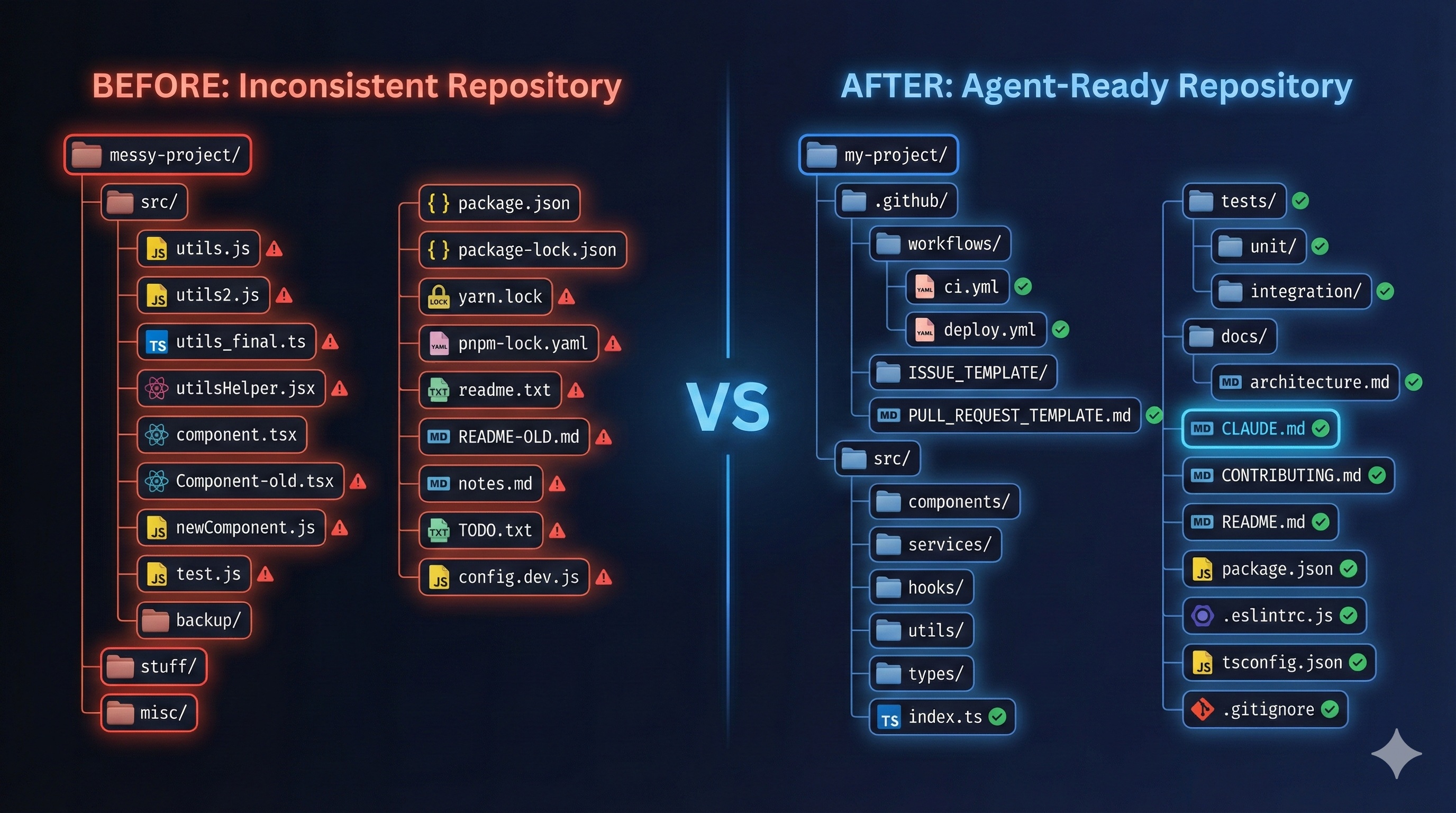
my-project/
├── src/
│   └── (hundreds of files, no organization principle)
├── package.json
├── README.md (3 lines, "A project for doing things")
└── .gitignore
When an AI assistant lands here, it’s lost. It will:
my-project/
├── .github/
│   ├── ISSUE_TEMPLATE/
│   │   ├── bug_report.md
│   │   ├── feature_request.md
│   │   └── config.yml
│   ├── PULL_REQUEST_TEMPLATE.md
│   └── workflows/
│       ├── ci.yml
│       └── deploy.yml
├── docs/
│   ├── architecture.md
│   ├── getting-started.md
│   └── api-reference.md
├── src/
│   ├── components/     # UI components (React)
│   ├── services/       # Business logic
│   ├── hooks/          # Custom React hooks
│   ├── utils/          # Pure utility functions
│   └── types/          # TypeScript definitions
├── tests/
│   ├── unit/
│   ├── integration/
│   └── e2e/
├── CLAUDE.md           # AI-specific instructions
├── CONTRIBUTING.md     # How to contribute
├── README.md           # Project overview
└── package.json
When an AI assistant lands here, it can:
CLAUDE.md for coding conventions and project specificsdocs/architecture.mdI tracked my AI-assisted development before and after restructuring:
| Metric | Before | After |
|---|---|---|
| Questions AI asked per feature | 5-8 | 1-2 |
| Time to implement simple feature | 45 min | 15 min |
| AI-introduced bugs | 30% of PRs | 5% of PRs |
| ”Let me check the codebase” delays | Constant | Rare |
The time I invested in repository structure paid itself back within a week.
This series will walk you through each aspect of agent-ready development:
You don’t need to restructure everything at once. Start with one thing:
Create a CLAUDE.md file in your repository.
Put these three things in it:
That’s it. That single file will immediately improve every AI interaction with your codebase.
In Part 2, we’ll dive deep into Foundation Files That Agents Actually Read—the specific files that AI assistants look for, what to put in them, and how to structure information for maximum utility.
This series is based on real patterns I’ve developed while building PopKit—a workflow orchestration plugin for Claude Code that implements these principles. If you want to skip ahead and get tooling that automates much of this structure, check it out. But the principles work regardless of what tools you use.
Have questions or want to share how you structure your repositories? Find me on X/Twitter or open a discussion on GitHub.
Next up: Part 2 - Foundation Files That Agents Actually Read (coming soon)